


Mercosur-EU Treaty
What is the Mercosur–European Union agreement?
A trade agreement between two of the world's largest economic blocs, connecting more than 700 million people
More than 700 million people
0
+
-
Mercosur, Argentina, Brazil, Paraguay, Uruguay, Venezuela, Bolivia
The world's sixth-largest economy, with a total population of 300 million (450 million including associated members), Mercosur is the EU's tenth-largest trading partner in goods.
-
The EU is Mercosur's second most important partner in trade of goods
17% of all trade originating from Mercosur
-
The EU is the largest investor in Mercosur countries with an investment volume of around 390 billion euros
-
In 2024, EU trade with Mercosur amounted to more than 111 billion euros: 55.2 billion in exports and 56 billion in imports
-
More than 80% of trade flows occurred between the EU and Brazil
-
Between 2014 and 2024, trade in goods between the EU and Mercosur grew by more than 36%: imports grew by more than 50% and exports by 25%
What changes does the Mercosur-EU trade agreement bring?
It will create one of the world's largest markets, with a population of 780 million, and a tariff relief agreement for goods and services.
- The two blocs represent approximately 25% of global GDP, 35% of global trade, and 10% of the world’s population.
- The EU will immediately launch 76% of its products
- Of these, 85% in the first year and 92% in 10 years grant preferential access to another 7.5%, only 0.5% are completely excluded
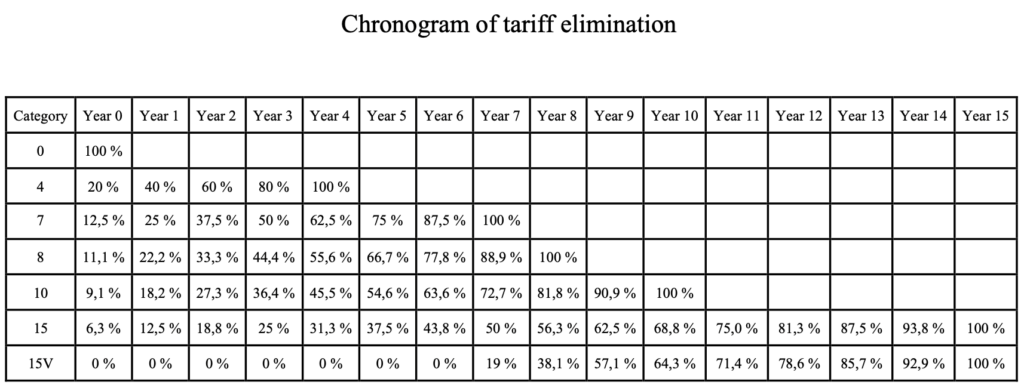
- The immediate reduction of Mercosur will only affect 15% of trade; the rest will be distributed over maturities of 4, 8, 10, and 15 years.
- Approximately 60% of EU imports will be liberalized in 10-15 years, reaching 91% (9% excluded).
Increase EU exports to Mercosur by 40% (€48.7 billion)
- In particular, vehicles (+200%), chemical products (+50%) and machinery (+35%) and South American exports will increase by 17% (8.9 billion euros, especially in the agri-food sector)
- Customs duties to the EU will be reduced by around 4 billion euros annually
Mercosur will eliminate import tariffs on passenger cars within 15 years, with longer timelines of 18 to 30 years for electric, hybrid, hydrogen and new technology vehicles
- Specific bilateral safeguard measures for the automotive sector can be applied up to 18 years after the agreement enters into force
- Reducing the “effective tariff” – for Mercosur, the effective tariff would go from 11% before the agreement to only 1%.
- The EU would reduce the effective tariff from 4% to 2%.
- Safeguard mechanism in case of an increase in imports from Mercosur that may cause or threaten serious injury
- Continuous monitoring of certain agricultural products every six months
Opportunities for small and medium-sized enterprises
SMEs
Clause 14 ITA
Business opportunities for Germany
- Mining
- Environment
- Logistics
- Infrastructure
- Renewable energy (solar energy, waste-to-energy, biomass)
- Oil and Gas
- Circular Economy
- IT
- AI (Artificial Intelligence)
- Consulting
- Urban Planning
- Strategic and Logistics Planning
- Public Tenders